Agentic AI · Tool · AI Architecture
Fine-grained or coarse-grained tools for AI agents?
Fine-grained or coarse-grained tools for AI agents? I’d pick neither end. Every tool you give an agent has a size. There’s no formal standard for it, just two well-known ends of a spectrum.
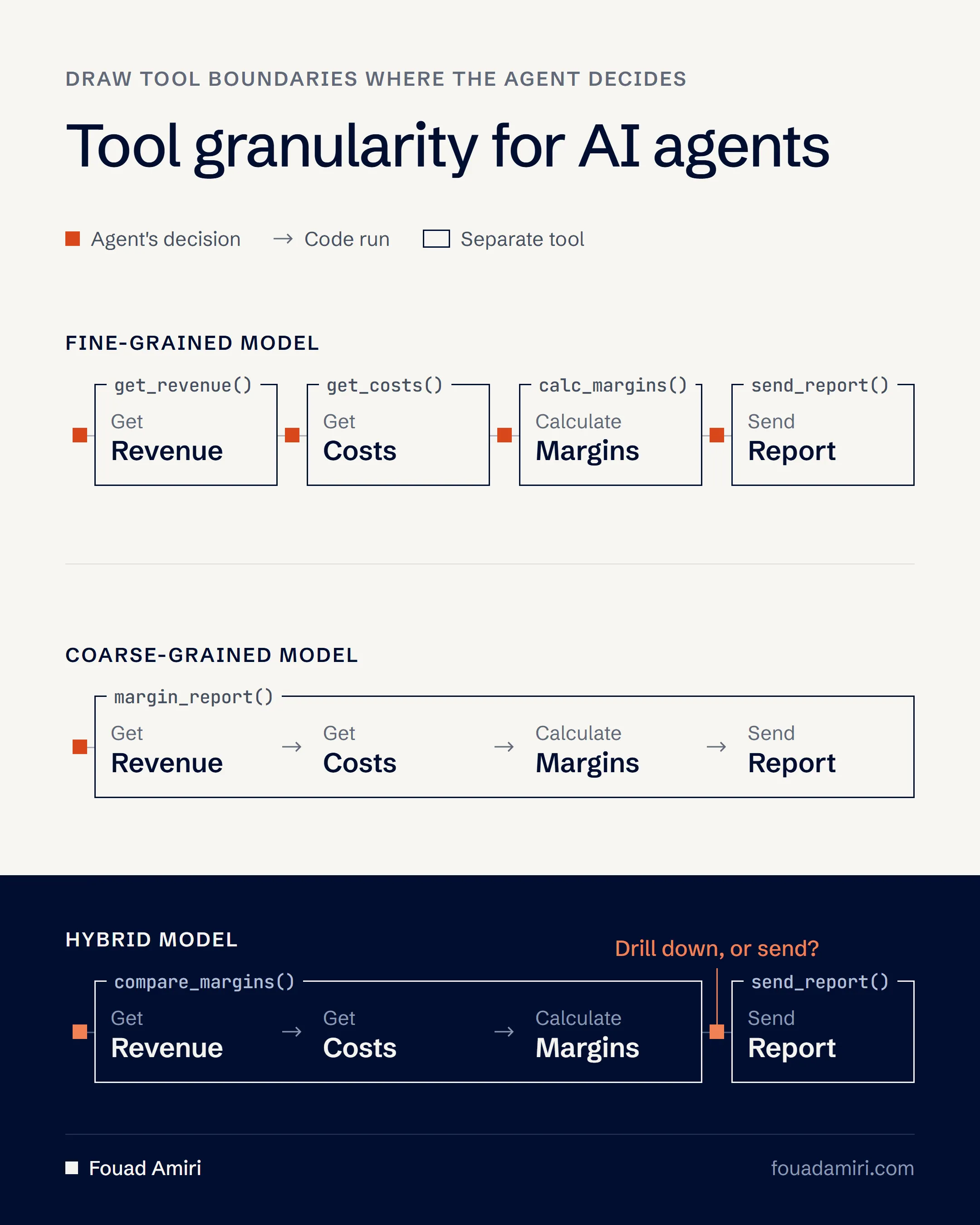
Fine-grained model: one tool per operation. get_revenue(), get_costs(). Flexible, but the agent has to sequence every step, and every step is another chance to get it wrong.
Coarse-grained model: one tool per workflow. margin_report(). Fast and predictable, until someone asks a question the workflow didn’t anticipate.
What works better is a hybrid model: draw a tool boundary wherever the agent needs to make a judgement, and keep the predictable steps together in code.
Take “How did margins change this quarter?”
→ Getting revenue and costs and calculating margins is one tool: compare_margins().
→ Whether to drill down by project, service or month stays with the agent.
→ Sending the report is a separate tool, with its own permissions.
Hybrid also means mixing sizes on purpose: workflow tools for the reports you run every week, and read-only primitives as an escape hatch for questions nobody anticipated.
Three rules I apply:
- If step B always follows step A, combine them in code.
- Split where the purpose or the permissions change. Reading and writing don’t share a tool.
- Judge the design based on the use case and requirements.
Anthropic’s and OpenAI’s guidance on tools points the same way: combine steps that always run in sequence instead of making the model chain them.
It’s the idea from my last post, probabilistic planning and deterministic execution, applied one level down.